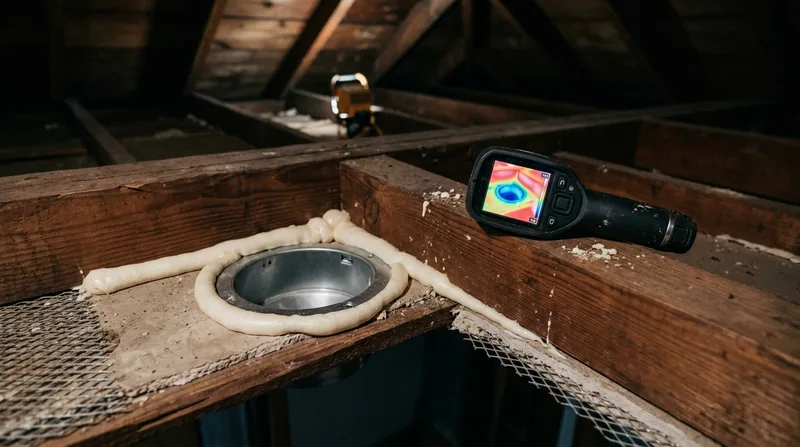




Air sealing in Lafayette is the foundation of any spray foam insulation job worth doing. Homes across Lafayette, West Lafayette, and the surrounding farm country face brutal temperature swings: January lows that plunge below zero, July heat that bakes attics past 140 degrees, and humid summers that flip vapor drive twice a year. These extremes find every gap, every crack, and every missed seam in your attic, walls, crawl spaces, and rim joists. Without proper air sealing, even premium insulation loses its R-value to convection and infiltration. We identify and seal those leaks with spray foam, stopping conditioned air from escaping and outside air from entering, then layer insulation on top. The result is a home that holds temperature, runs its heating and cooling systems less, and stops the ice dams and frost that plague older Victorians and mid-century homes on Ninth Street Hill, in Centennial, and across the east side.
Why Air Sealing Matters in Lafayette's Climate
Lafayette winters are unforgiving. Cold air doesn't just leak in through gaps in your attic, it creates pressure imbalances that pull warm air out of living spaces and draw moisture-laden outside air into wall cavities and crawl spaces. That moisture condenses when it hits cold framing, rotting sill plates and band joists. In summer, the reverse happens: hot, humid air pushes into your attic and crawl space, overwhelming your air conditioning and feeding mold growth on cool surfaces. Ice dams form in January and February when heat loss through an unsealed attic melts snow on the roof, refreezing at the eaves and backing water into your walls. Air sealing stops these cycles before they start.
- We locate thermal bypasses using blower-door diagnostics and infrared imaging to find leaks you cannot see with your eyes.
- We seal rim and band joists, the single largest uninsulated cavity in most homes, stopping cold air from rising into the first-floor walls.
- We seal the attic floor perimeter, all penetrations for electrical boxes and plumbing, and the seams where roof decking meets the top plates.
- We air seal crawl spaces before insulating them, preventing outside air from short-circuiting your insulation and carrying moisture into the foundation.
- We seal garage walls and ceilings where they adjoin conditioned space, cutting heating and cooling loss that homeowners often overlook.
Proper air sealing is what separates a competent insulation job from a mediocre one that leaves your utility bills unchanged.
Key info: Lafayette and West Lafayette homes built before 1980 were rarely insulated to code. Balloon-framed Victorians and foursquares on Highland Park and Perrin have empty wall cavities running from basement to attic. Pre-1960 Cape Cods and ranches with knee walls have original mineral wool or cellulose that has settled to half its original thickness. Air sealing these homes without removing old insulation first is a waste of time. We remove failed insulation and seal the cavities clean before re-insulating them. See insulation removal for details on that precondition.
For guidance on what air sealing means in code and what your local building department requires, check the Indiana Department of Natural Resources energy code resources or contact Lafayette's building department directly. They can tell you whether your address falls under the 2020 or 2023 energy code and what ventilation, ignition barriers, and thermal barriers apply to your specific job.
How We Perform Air Sealing in Lafayette Homes
Air sealing is methodical work. We start with a blower-door test or a simple visual inspection to map where air is moving. Then we seal every leak in sequence, using spray foam to fill large cavities and caulk or weatherstripping for smaller gaps. We work from the inside where possible, sealing attic floor perimeters and rim joists before we ever touch the exterior. In crawl spaces, we seal the band joist first, then the perimeter walls and all mechanical penetrations. The goal is to create a continuous air barrier, unbroken by gaps larger than a quarter inch. Only then do we insulate on top of that sealed surface. This sequence prevents the foam from being wasted in voids that could have been sealed cheaper with caulk, and it ensures your insulation performs at its rated R-value.
- We perform a blower-door test or visual assessment to identify air leaks and thermal bypasses in your attic, walls, and crawl space.
- We seal the attic floor perimeter, all electrical boxes, plumbing vents, and HVAC penetrations with spray foam or caulk.
- We seal rim and band joists completely, including the rim board itself and the rim cavity where it sits on the foundation.
- We seal crawl space band joists, foundation walls, and mechanical chases before installing insulation on the rim and walls.
- We air seal garage-to-home walls and ceilings, stopping conditioned air loss into an unconditioned space.
- We use closed-cell spray foam for high-moisture areas like crawl spaces and rim joists, and open-cell foam or caulk for dry attics where vapor permeability is an asset.
Once air sealing is complete, insulation performs as designed. Without it, you are paying for R-value you do not get.
Example: A 1950s ranch in Dayton with a vented crawl space and original fiberglass batts in the rim joist cavity. The rim cavity is open to the crawl space, which is vented to outside. Cold air leaks through the rim, through the fiberglass, and into the first-floor walls. The homeowner's heating bill is high, and the first-floor rooms are cold in winter. We seal the rim joist completely with closed-cell foam, then wrap the rim and the sill plate. Air sealing alone cuts the heating load by 10 to 15 percent. Adding insulation to the rim cavity doubles that savings. See rim joist insulation for the full picture of that job.
Air Sealing Methods and Approaches
| Approach | Description | Best for |
|---|---|---|
| Blower-door diagnostic air sealing | We pressurize your home with a calibrated blower door, then identify and seal leaks using infrared imaging and smoke pencils. Allows us to target the highest-impact leaks first. | Whole-home air sealing, energy audits, homes with persistent drafts or uneven heating and cooling. |
| Attic floor perimeter sealing | We seal the top plate of exterior walls, all electrical boxes and fixture penetrations, plumbing vents, and the soffit edges where attic meets the exterior. Spray foam fills large voids; caulk or weatherstripping handles smaller gaps. | Attic insulation retrofit, ice dam prevention, homes with high heating and cooling loss. |
| Rim and band joist air sealing | We seal the rim board, the rim cavity, the sill plate, and the rim-to-foundation joint with closed-cell spray foam. This is a high-impact, high-moisture zone that must be sealed and insulated together. | Crawl space homes, cold first floors, vented crawl space conditioning, moisture control in the rim cavity. |
| Crawl space air sealing before encapsulation | We seal all band joists, the rim perimeter, and foundation wall penetrations with closed-cell foam before insulating the rim and walls. This prevents outside air from entering the crawl space and reduces moisture infiltration from the soil. | Vented crawl spaces, damp crawl spaces, homes with moisture or condensation in the crawl space. |
| Garage-to-home air sealing | We seal the walls and ceilings that separate your garage from conditioned living space. Gaps around doors, windows, and mechanical chases are sealed with foam or caulk to stop air leakage into the unconditioned garage. | Garages attached to homes, energy efficiency in bonus rooms or second stories over garages, odor and fume control. |
Air Sealing Cost in Lafayette: What to Expect
Air sealing cost in Lafayette starts at $650 for a straightforward attic floor perimeter seal on a modest home. Most jobs in the $1,200 to $3,500 range cover an attic, rim joists, and garage-to-home sealing combined. Large homes, crawl spaces, or jobs requiring removal of old insulation before sealing run higher. Cost depends on the square footage of your attic and rim, the number of penetrations to seal, access to the rim cavity, and whether old insulation must be removed first. A 1,200-square-foot ranch with a vented crawl space and a garage will cost less than a 3,000-square-foot two-story with a finished basement and complex roof geometry. We provide a written estimate with R-value and thickness specifications for any insulation component, so you know exactly what you are paying for and why.
Get two or three estimates before you book. A firm price per square foot or per board foot is a red flag; spray foam is measured on site at the board foot, and the price depends on the thickness and foam type you choose. An estimate with no R-value or thickness is worthless. See our pricing page for typical ranges and what drives the cost up or down.
What to Look for When Hiring a Spray Foam Contractor Near Lafayette
Air sealing is a foundational service, and the contractor you hire sets the tone for the entire insulation job. Look for a contractor with a local address and local phone number, not an out-of-state trailer crew that sprays a job in an afternoon and disappears. Ask for references from recent jobs in your neighborhood. Verify that the contractor is fully insured and can provide a certificate of insurance naming your address as an additional insured. Get a written estimate that specifies R-value, thickness, and the foam type (closed-cell or open-cell). Do not accept an estimate that quotes only a price per square foot or a lump sum with no breakdown. Ask whether the contractor pulls permits and coordinates with your local building department. In Lafayette, air sealing does not usually trigger a permit, but attic ventilation rules and thermal barrier requirements do apply if foam is being installed as well, so your contractor should be familiar with what applies at your address. If your home is in an HOA like New Chauncey or Hills and Dales, ask whether the contractor has experience with HOA approval for exterior work. Most importantly, ask how the contractor handles the cure period: mechanical ventilation should run during and after spraying, and re-entry should not be permitted for 24 to 48 hours. If a contractor promises immediate re-entry or no smell, they are either lying or using inferior foam. Call Lafayette Spray Foam Insulation at (765) 441-6823 for a free estimate with no obligation to book.
Air Sealing in Lafayette: Pricing Guide
| Service | Price | Details |
|---|---|---|
| Attic floor perimeter air sealing | Starting at $650 | Includes sealing top plate, electrical boxes, plumbing vents, and soffit edges. Cost rises with attic size and complexity of penetrations. |
| Rim and band joist air sealing | Starting at $800 | Includes rim board, rim cavity, sill plate, and rim-to-foundation joint with closed-cell foam. Linear feet of rim and crawl space access determine final cost. |
| Whole-home air sealing with blower-door diagnostics | Starting at $1,400 | Includes blower-door test, attic floor perimeter, rim joists, garage-to-home sealing, and all mechanical penetrations. Price varies by home size and complexity. |
| Crawl space air sealing before insulation | Starting at $1,200 | Includes band joist, rim perimeter, and foundation wall penetrations with closed-cell foam. Cost depends on crawl space size, access, and moisture conditions. |
| Air sealing with insulation removal and re-insulation | On estimate | Removal of failed insulation, air sealing, and new insulation installation require on-site inspection to price accurately. Contact for free assessment. |
| Free estimate | No charge | Response within 24 hours at (765) 441-6823. Written estimate with R-value and thickness specs, no obligation to book. |
Indicative pricing, the exact cost depends on square footage, finish, and site access. Free personalized estimate within 24h at (765) 441-6823.


