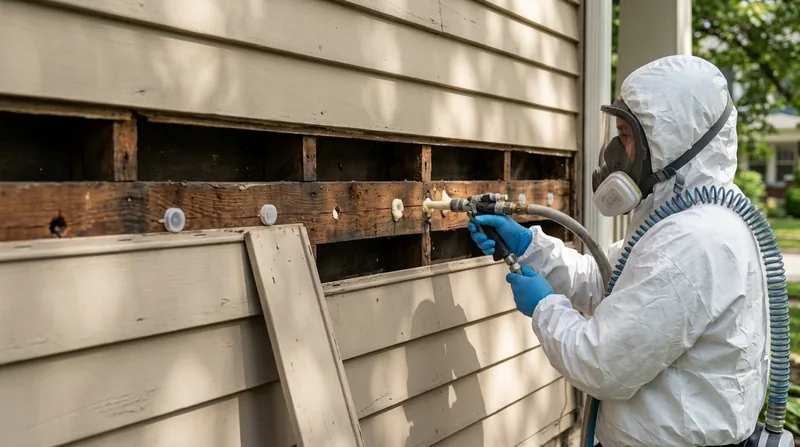




Homes across Lafayette and West Lafayette face a persistent insulation challenge: the pre-1980 balloon-framed houses that line Ninth Street Hill, Centennial, and the older east side neighborhoods were built with hollow wall cavities that are now either empty or filled with settled, compressed insulation that no longer performs. Winter cold and summer humidity drive energy loss through these walls, while the seasonal temperature swings that define north-central Indiana agriculture (below zero in January, humid stagnation in July) mean vapor drive flips direction twice a year, making air sealing and proper insulation critical. Wall and injection foam insulation in Lafayette reaches into those cavities without demolition, seals the air leaks, and restores thermal resistance where it matters most. We inject closed-cell or open-cell foam directly into the wall cavity from the exterior or interior, creating a continuous thermal and air barrier that works year-round. This page explains how the work is done, what it costs, and how to choose a contractor you can trust.
Why Wall and Injection Foam Insulation Matters in Lafayette's Older Neighborhoods
The neighborhoods that define Lafayette's character, Victorian foursquares on Ninth Street, Cape Cods and ranches on the east side, the tree-lined streets near Columbian Park, were built when insulation standards were minimal and air sealing was not a consideration. Balloon framing and platform construction left wall cavities exposed to the full temperature range of a Wabash River winter and summer. Over decades, original insulation settles, fiberglass batts develop gaps, and the walls become thermal sieves. Injection foam addresses this directly: it fills the cavity completely, seals every air leak, and does not require tearing open walls to do it.
- We drill small access holes (typically 1.5 inches) from the exterior or interior at strategic points along the wall.
- We inject closed-cell or open-cell foam into the cavity under controlled pressure, filling every void and sealing all cracks and gaps.
- The foam expands slightly, conforms to the cavity shape, and hardens into a solid, continuous insulation layer.
- We patch the access holes and the wall is restored to its original appearance with no structural damage.
This method works on homes built from the 1870s through the 1970s, and on any retrofit where removing drywall is not practical or affordable.
Key info: A 1920s foursquare in Lafayette with 2,000 square feet of exterior wall can lose 30 to 50 percent of its heating energy through uninsulated or poorly insulated walls. Injection foam typically adds R-4 to R-7 per inch, depending on foam type and cavity depth, and seals the air leaks that fiberglass alone cannot address.
For more details on how we approach insulation work across all home types in Lafayette, see our homepage.
How We Inject Foam Insulation: Process and Local Examples
Injection foam insulation is precise work that requires careful planning, proper equipment, and a thorough understanding of wall construction. We start with a site visit to assess the wall cavity depth, identify any existing insulation, locate utilities and obstructions, and determine the best injection points. We then choose the foam type (closed-cell for maximum R-value and moisture control, open-cell for cost-efficiency and sound dampening), set up ventilation and safety equipment, and inject the foam in controlled passes to avoid excessive pressure or overflow.
- We locate utilities (plumbing, electrical, gas) using a stud finder and visual inspection before drilling any access holes.
- We drill small, carefully positioned holes at intervals along the wall, typically every 16 to 24 inches vertically.
- We inject foam using a proportioned spray rig, monitoring pressure and flow to fill the cavity without over-expansion.
- We allow the foam to cure for 24 to 48 hours before patching access holes and restoring the wall surface.
- We verify R-value and thickness on the estimate and confirm completion in writing with photographs and measurements.
The entire process is non-invasive and preserves the home's interior finishes and exterior appearance.
Local example: A 1950s ranch in Dayton with 1,200 square feet of exterior wall and no cavity insulation takes approximately 4 to 6 hours to inject and patch. The homeowner can live in the home during the work and re-enter the wall cavities within 48 hours. We inject 3.5 inches of closed-cell foam at R-21 equivalent, sealing the entire cavity and all rim board and band joist transitions.
For information on how injection foam integrates with our broader air sealing approach, see that service page.
Wall Insulation Methods: Closed-Cell vs. Open-Cell vs. Retrofit Removal
| Approach | Description | Best for |
|---|---|---|
| Closed-cell injection foam | Rigid, high-density foam (R-6 to R-7 per inch) injected into cavities; creates air and moisture barrier; takes 24 to 48 hours to cure. | Walls with moisture risk, high humidity environments, maximum R-value in shallow cavities, vapor control priority. |
| Open-cell injection foam | Lower-density, semi-rigid foam (R-3.5 to R-4 per inch) injected into cavities; allows vapor transmission; faster cure (8 to 12 hours); lower cost per board foot. | Interior retrofit walls in dry climates, cost-conscious projects, sound dampening, homes where vapor permeability is desired. |
| Removal and replacement | We remove old, failed, or contaminated insulation (fiberglass, cellulose, vermiculite) and inject new foam in a single scope; requires careful handling and disposal. | Homes with settled or damaged insulation, pre-1980 stock with deteriorated fiberglass, retrofit projects that require cavity cleaning first. |
| Partial wall cavity injection | Injecting foam into select walls or sections (e.g., exterior walls only, north-facing walls, basement rim joists) rather than the entire home at once. | Phased projects, budget-conscious homeowners, homes where some walls already have adequate insulation, prioritizing high-loss areas first. |
Wall and Injection Foam Insulation Cost in Lafayette: What to Expect
Wall and injection foam insulation pricing depends on cavity depth, foam type, wall area, existing insulation condition, and access difficulty. Closed-cell foam costs more per board foot but delivers higher R-value and moisture control. Open-cell foam is less expensive but requires thicker cavities to achieve the same R-value. Removal of old insulation adds time and disposal cost but is necessary when cavities contain settled fiberglass or other failed insulation. A typical Lafayette home with 1,500 to 2,000 square feet of exterior wall can expect injection foam costs to range from $2 to $4 per square foot depending on these variables.
The best way to understand cost for your specific home is to request a free, no-obligation estimate. We measure your walls on site, identify the cavity depth and existing insulation, assess access and utility hazards, and provide a written estimate with R-value, thickness, foam type, and total cost. We also explain what factors might change the price (e.g., if we discover deeper cavities, more settled insulation, or utility conflicts that require rerouting). Getting 2 to 3 estimates from different contractors is smart: compare R-value and thickness specifications, not just the bottom-line price, because a lower bid may specify thinner foam or lower R-value that will not solve your problem.
For a detailed overview of our pricing structure and service areas, see our pricing page.
What to Look for When Hiring a Spray Foam Insulation Contractor Near Me in Lafayette
The spray foam insulation market includes both local, independent shops and national franchises. Both can do good work, but the difference is in accountability and transparency. A local contractor with a local address and local phone number is reachable when questions arise after the job. A national franchise or out-of-state rig-and-run crew may spray a job in an afternoon and be unreachable if the smell lingers, if the foam is too thick, or if the R-value does not match the estimate. Here is what to verify when you call a contractor near Lafayette.
- Ask for written estimates that specify R-value per inch, thickness in inches, foam type (closed-cell or open-cell), and total square footage or board feet.
- Verify that the contractor is fully insured and can provide a current certificate of insurance naming you as additional insured on the general liability policy.
- Ask about the cure time and re-entry window; any contractor promising immediate re-entry (same day) is cutting corners and should be avoided.
- Request references from recent jobs in Lafayette, West Lafayette, or Battle Ground and call at least two to ask about smell, cure time, and whether the work matched the estimate.
- Confirm that the contractor understands local permitting and building code requirements for your address; Lafayette and West Lafayette have different registration requirements, so do not assume reciprocity.
- Ask how the contractor handles moisture or contamination in the wall cavity; any contractor willing to spray over wet insulation or a leaking rim board should be rejected immediately.
Once you have narrowed the field, call us at (765) 441-6823 for a free estimate. We will visit your home, assess your walls, and provide a detailed, written estimate with no pressure to book.
For more information or to request an estimate, see our contact page.
Wall & Injection Foam Insulation in Lafayette: Pricing Guide
| Service | Price | Details |
|---|---|---|
| Open-cell injection foam (standard) | Starting at $2.00/sq ft | Typical for 3.5-inch cavity with R-12 equivalent; includes drilling, injection, curing, and patching holes |
| Closed-cell injection foam (premium) | Starting at $3.50/sq ft | 3.5-inch cavity at R-21 equivalent; higher cost reflects moisture control and maximum R-value in shallow spaces |
| Removal and re-injection | Starting at $2.50/sq ft | Includes removal of old insulation, cavity cleaning, and new closed-cell or open-cell foam injection; cost varies by volume of old material |
| Partial wall or rim joist injection | On estimate | Smaller scopes (basement rim joists, single walls, band joists) priced per linear foot or board foot; typically $400 to $1,200 depending on extent |
| Travel and estimate | Free | No charge for site visit, measurement, or written estimate; response within 24 hours at (765) 441-6823; Lafayette and surrounding areas |
Indicative pricing, the exact cost depends on square footage, finish, and site access. Free personalized estimate within 24h at (765) 441-6823.


