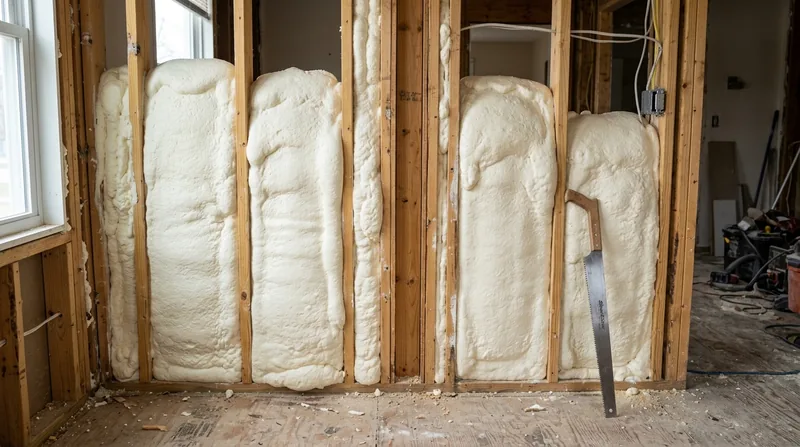




Open Cell Spray Foam Insulation in Lafayette is the cost-effective answer to the seasonal temperature swings and humidity that dominate north-central Indiana attics. Lafayette and West Lafayette sit in farm country where homes face brutal January freezes that drive ice dams into soffit and fascia, and July heat that bakes attic temperatures past 140 degrees Fahrenheit. Open cell foam fills cavities and seals air leaks at a lower cost than closed cell, delivers solid R-value per inch, and dampens the sound that travels through walls and floors. Whether your home sits on the older Ninth Street Hill and Centennial blocks with balloon-frame walls over empty cavities, or in the post-1990s subdivisions south of the city with bonus rooms and cathedral ceilings, open cell spray foam stops the seasonal moisture and temperature swings that degrade fiberglass and leave you chasing comfort all year. We have been installing spray foam insulation and air sealing across Greater Lafayette since 2012, and we help homeowners understand when open cell is the right choice and when a different approach makes more sense.
Why Open Cell Spray Foam Matters in Lafayette Attics and Walls
The climate and building stock of Lafayette create two signature failure modes that open cell spray foam addresses directly. First, the seasonal vapor drive: cold January air pulls moisture out of the attic and into the rim joist and band joist, while humid July air pushes moisture back up into the attic. Open cell foam is vapor-permeable, meaning it allows the attic to breathe and equalize pressure with the conditioned space below, stopping the moisture cycling that rots wood and collapses fiberglass batts. Second, the age of the housing stock: homes built before 1960 in neighborhoods like Centennial, Highland Park, and the older east side often have balloon-framed walls with empty cavities between studs, and knee walls under sloped ceilings where fiberglass never stays in place. Open cell foam fills those cavities completely, seals air leaks that fiberglass cannot reach, and stays put because it adheres to wood and drywall.
- Open cell foam stops ice dams by sealing the attic air leaks that allow warm interior air to melt snow on the roof.
- Vapor permeability allows moisture to move through the foam and out of the attic, preventing condensation on framing and sheathing.
- Lower density means lower cost per board foot compared to closed cell, making it ideal for attic top-ups and sound dampening.
- Adheres to wood, drywall, and metal, so it fills cavities that fiberglass cannot and stays in place through temperature swings.
- Reduces noise transmission through walls, ceilings, and floors, a real benefit in the student rental neighborhoods near Purdue campus.
When you compare open cell to fiberglass, the difference is in performance and durability. Fiberglass settles, compresses, and loses R-value in the presence of air movement and moisture. Open cell foam stays at full thickness, maintains its R-value, and actively seals the air leaks that fiberglass leaves open.
Key info: The Indiana Building Code and the local building department in Lafayette govern attic ventilation, ignition barriers, and thermal barriers. Open cell foam requires a thermal barrier (usually 1/2-inch drywall) to meet code. We help you navigate what applies at your address, and we defer to the building official on your permit.
For more detail on how open cell compares to the closed cell option, see our page on Closed Cell Spray Foam Insulation.
How We Install Open Cell Spray Foam in Lafayette Homes
The installation process is straightforward, but the details matter. We start with a site inspection to measure the space, identify air leaks, check for moisture or contamination, and verify that the substrate is clean and dry. Open cell foam cures by reacting with moisture in the air, so we control the temperature, humidity, and ventilation during the spray to ensure the foam sets properly. We then allow a twenty-four to forty-eight hour re-entry window before the space is safe to occupy or work in again.
- We inspect the attic, rim joist, or wall cavity to confirm it is clean, dry, and free of contamination before we spray.
- We establish mechanical ventilation during the spray and cure to control off-gassing and allow the foam to set at the correct rate.
- We spray the foam in controlled passes, typically 1 to 2 inches per pass, to achieve the specified thickness and R-value without over-application.
- We allow the manufacturer ratio and drum temperature to be maintained throughout the job so the chemical reaction is complete and uniform.
- We respect the re-entry window and clearly mark the space so no one enters during cure.
- We trim excess foam and install any required thermal barrier or ignition barrier after cure is complete.
The entire process, from inspection to trim-out, typically takes one to three days depending on the size of the space and the complexity of the layout.
Example: A 1,500-square-foot attic in a 1950s ranch in Battle Ground with 6 inches of settled fiberglass and exposed rim joist. We remove the old insulation, clean and inspect the framing, spray 5.5 inches of open cell foam to achieve R-21, seal the rim joist cavity, and install a thermal barrier. Total time: two days. The homeowner stays out for 48 hours, then re-enters to a sealed, insulated attic with no air leaks and no moisture cycling.
To learn more about the removal and replacement process, visit our page on Insulation Removal.
Open Cell Spray Foam Insulation Methods and Applications
| Approach | Description | Best for |
|---|---|---|
| Attic fill and air sealing | Spray open cell foam to full attic depth (typically 5.5 to 7 inches for R-21 to R-26), seal rim joist and band joist, and seal penetrations and air leaks. | Homes with vented attics, ice dams, or settled fiberglass; Lafayette and West Lafayette ranches and capes. |
| Sealed or unvented attic deck | Spray open cell foam directly to the roof sheathing to create a sealed attic cavity, stopping air leakage and moisture intrusion. | Cathedral ceilings, bonus rooms, attic conversions, and homes where attic ventilation is not feasible. |
| Knee wall and sloped ceiling retrofit | Inject open cell foam into cavities behind drywall or under sloped ceilings to fill empty spaces and seal air leaks without demolition. | 1920s to 1960s homes with knee walls, Centennial and Highland Park Victorians, and pre-1980 balloon-frame construction. |
| Rim joist and band joist sealing | Spray open cell foam into the rim joist cavity where the band joist meets the foundation to stop air leakage and moisture intrusion at the rim. | All homes, especially those with vented crawl spaces or basements where the rim is the primary air leak pathway. |
| Garage ceiling and wall insulation | Spray open cell foam to garage ceilings and walls to reduce heat loss to the unconditioned space and dampen noise from vehicles. | Garages with living space above, bonus rooms over garages, and sound dampening in attached garages near bedrooms. |
Each application starts with the same principle: open cell foam fills the cavity completely, seals air leaks, allows vapor to move through the system, and stays in place through the seasonal temperature and humidity swings that dominate the Lafayette climate.
Open Cell Spray Foam Insulation Cost in Lafayette: What to Expect
Open cell spray foam costs typically start at $0.55 per board foot, with the final price depending on the size of the space, the depth of foam required, access, and the complexity of air sealing. A typical attic in Lafayette ranges from $1,500 to $4,500 depending on square footage and the R-value target. Rim joist and band joist sealing runs $400 to $1,200 for an average home. Sealed attic decks and cathedral ceilings cost more because they require greater thickness and more precision in application. The best way to get an accurate number is a free on-site estimate, where we measure the space, identify the air leaks, and quote the work in board feet and labor.
Factors that move the price include the current insulation and whether it needs to be removed first, the accessibility of the space (low attics cost more because the work is slower), the thickness required to meet your R-value target, and whether rim joist and air sealing are included. If you have existing fiberglass or cellulose that needs to be hauled out, budget separately for insulation removal, which is a precondition of any retrofit.
Getting 2 or 3 estimates is smart because it gives you a sense of the market and helps you spot the outliers. A legitimate estimate includes the R-value, the thickness in inches, the board footage, the labor, and the timeline. If an estimate has no R-value and no thickness, or quotes a price far below market with no inspection, that is a sign to walk away. For a detailed breakdown of pricing across all our services, see our pricing page.
Open Cell Spray Foam Insulation Near Me: What Lafayette Homeowners Should Know When Hiring a Contractor
The spray foam market in Greater Lafayette includes local independent shops, national franchises, and out-of-state crews that roll into town, spray a job in an afternoon, and disappear. The difference is in accountability and quality control. A local contractor with a local address and local plates is reachable when something goes wrong, carries verifiable insurance, and has a reputation in the community to protect. When you call for an estimate, ask for proof of insurance, check references from recent jobs in Lafayette or West Lafayette, and verify that the contractor understands the local building code and permits.
- Ask for proof of insurance and verify that the coverage is current and adequate for the scope of work.
- Request references from at least three recent jobs in Lafayette, Battle Ground, or nearby areas, and follow up with a phone call.
- Confirm that the contractor understands the thermal barrier and ignition barrier requirements in the Lafayette building code.
- Get a written estimate that includes the R-value, thickness in inches, board footage, labor, and timeline before you commit.
- Verify that mechanical ventilation during cure and a stated re-entry window are part of the scope, not an afterthought.
- Confirm that the contractor will not spray over wet, contaminated, or leaking substrates, and will walk away if moisture is present.
If you have questions about permits or the local building code, the Lafayette Building Department is the authority on what applies at your address. We help homeowners navigate those requirements, and we always defer to the building official. Ready to get started? Contact us for a free estimate at (765) 441-6823, and we will be in touch within 24 hours.
Open Cell Spray Foam Insulation in Lafayette: Pricing Guide
| Service | Price | Details |
|---|---|---|
| Attic open cell spray foam | Starting at $0.55/board ft | Includes inspection, removal of old insulation if needed, foam application to specified R-value, and air sealing of rim joist and penetrations |
| Rim joist and band joist sealing | Starting at $0.55/board ft | Sealing the rim cavity where the band joist meets the foundation; cost varies by linear footage and access to the cavity |
| Sealed attic deck or cathedral ceiling | Starting at $0.55/board ft | Spray to roof sheathing for unvented attics; requires greater thickness and precision, so typical projects run higher than standard attic fill |
| Garage ceiling and wall insulation | Starting at $0.55/board ft | Cost depends on ceiling area and wall cavity depth; sound dampening and thermal control in attached garages are primary drivers |
| Insulation removal and disposal | On estimate | Hauling out old fiberglass, cellulose, or failed foam requires on-site assessment of volume, contamination, and access constraints |
| Free estimate and 24-hour response | No charge | Call (765) 441-6823 for a site inspection, measurements, and written quote with R-value, thickness, board footage, and timeline |
Indicative pricing, the exact cost depends on square footage, finish, and site access. Free personalized estimate within 24h at (765) 441-6823.


