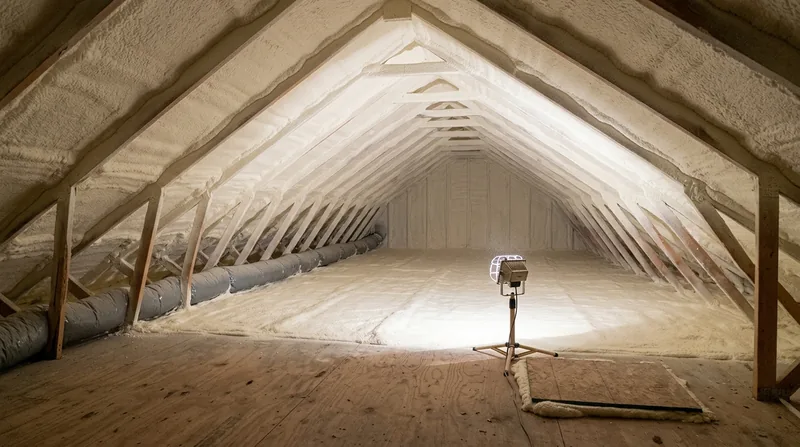




Lafayette and West Lafayette face one of the harshest climates in Indiana for attic performance. Winter temperatures drop below zero; summer heat climbs into the 90s; and from November through March warm air leaking out of the living space into the attic is what turns into ice dams along the eaves. Attics in the older Victorians and foursquares of Ninth Street Hill, Centennial, and Highland Park sit over balloon-framed walls with empty cavities. Mid-century Cape Cods and ranches in Vinton and Columbian Park carry decades of settled fiberglass that no longer seals. The newer two-stories over crawl spaces in south Lafayette, Dayton, and Battle Ground often have bonus rooms built over garages where attic insulation was never installed at all. Attic spray foam insulation in Lafayette addresses all three problems at once: it seals the attic floor, stops air leakage at rim joists and band joists, and creates a conditioned space that does not sweat, freeze, or leak. We have been insulating attics across Greater Lafayette since 2012.
Why Attic Spray Foam Insulation Matters in Lafayette's Climate
Lafayette's winter cold and summer humidity create a vapor-drive problem that fiberglass cannot solve. When outside air leaks into an attic in December, it carries moisture that condenses on cold surfaces. When summer humidity rises, it drives moisture into the attic from below. Fiberglass batts do not stop air movement, so the problem repeats every season. Ice dams form along roof lines where warm attic air melts snow; water backs up under shingles and runs down into walls. Settled blown-in insulation compacts over time and leaves gaps at rim joists where the roof meets the walls of the house.
- Spray foam seals the attic floor and stops air leakage that fiberglass cannot block.
- Closed-cell foam creates a vapor barrier that prevents moisture from moving into or out of the attic.
- Open-cell foam breathes and is appropriate for vented attics where vapor management is not a concern.
- A sealed attic eliminates ice dams by keeping warm air from leaking into the roof cavity.
- Proper air sealing at rim joists and band joists prevents conditioned air from escaping into crawl spaces and basements.
Choosing the right foam type and thickness for Lafayette's climate is the difference between a job that lasts twenty years and one that fails in five.
Key info: The City of Lafayette Building Department enforces the Indiana Energy Code. Attic ventilation, ignition barriers, and thermal barriers are governed by code at your address. We help you navigate what applies; the building official has the final say. Call (765) 441-6823 to discuss your specific attic and code requirements.
For details on permitting and code compliance across Greater Lafayette, consult the City of Lafayette Building Department or your local municipality.
How We Approach Attic Spray Foam Insulation in Lafayette
A proper attic spray foam job starts with a walkthrough. We measure the attic floor, identify air leaks at rim joists, band joists, and penetrations, and look at what insulation is already there. We then recommend closed-cell or open-cell foam based on your attic's ventilation status, your vapor drive pattern, and your energy goals. We always pull the right permits and schedule a time that works for your family.
- We walk your attic and take measurements to calculate board feet and confirm R-value requirements.
- We identify air leaks at rim joists, band joists, ductwork, and electrical penetrations.
- We recommend closed-cell or open-cell foam based on your attic's existing ventilation and your moisture profile.
- We set up mechanical ventilation during the spray and curing process to manage fumes.
- We spray the foam in controlled passes, maintaining proper thickness and manufacturer ratio at every step.
- We provide a written estimate with R-value, thickness, and square footage before we start.
Once the foam cures, you can return to the attic after the re-entry window closes, typically twenty-four to forty-eight hours.
Local example: A 1920s bungalow in Highland Park with a 900-square-foot attic over balloon-framed walls and a settled 4 inches of fiberglass gets a full spray foam job: closed-cell foam at 5.5 inches on the attic floor, rim joist sealing, and air sealing around the HVAC ductwork. The homeowner stops losing conditioned air into the crawl space and eliminates the ice dam that has been backing water into the master bedroom every January.
See how this works alongside other air sealing strategies in our air sealing service page.
| Approach | Description | Best for |
|---|---|---|
| Closed-Cell Spray Foam | High-density foam at 5.5 to 6.5 inches. Creates a vapor barrier and structural strength. R-value 6.5 per inch. | Sealed attics, ice dam prevention, moisture control in humid climates like Lafayette. |
| Open-Cell Spray Foam | Lower-density foam at 7 to 8 inches. Breathable, allows vapor to pass through. R-value 3.5 to 3.7 per inch. | Vented attics, sound dampening, budget-conscious retrofits where vapor management is not critical. |
| Spray Foam with Blown-In Top-Up | Foam at rim and band joists plus blown-in fiberglass or cellulose on the attic floor. Lower cost, partial air sealing. | Homes where budget is tight and existing attic insulation is sound but thin. |
| Full Attic Replacement | Complete removal of old insulation, air sealing, and full spray foam coverage of the attic floor and rim. | Homes with failed or contaminated insulation, severe air leakage, or ice dam history. |
Attic Spray Foam Insulation Cost in Lafayette: What to Expect
Attic spray foam insulation in Lafayette typically starts at $1.50 per square foot for closed-cell foam on a straightforward attic floor with good access. A 1,000-square-foot attic with rim joist sealing and standard thickness runs between $1,500 and $2,000. The final cost depends on the attic's size, the thickness and R-value you need, whether old insulation must be removed, and how much air sealing is required at penetrations and band joists.
Homes with older, settled insulation that must be removed cost more because we charge separately for removal and disposal. Attics with limited access, low headroom, or complex rafter geometry take longer and add labor. The number of penetrations (electrical, plumbing, HVAC) and the condition of the substrate also affect the final price. A sealed attic in a 1920s Cape Cod in Columbian Park with settled fiberglass, rim joist gaps, and band joist air leaks will cost more than a simple top-up of a sound attic in a newer home.
We always provide a written estimate that shows R-value, thickness, square footage, and the specific work included. Get two or three estimates from different contractors so you can compare scope, not just price. The lowest bid often means less coverage, thinner foam, or skipped air sealing. The highest bid may include services you do not need. A middle estimate that spells out exactly what you get is usually the honest one.
Visit our pricing page for more detail on how we structure estimates and what factors move the cost up or down.
What to Look for When Hiring a Spray Foam Insulation Contractor Near Me in Lafayette
The spray foam insulation trade has two kinds of bad actors: rig-and-run crews from out of state who spray a job in an afternoon and disappear, and national franchises that sell high prices and low accountability. A local contractor with a local address, local plates, and a local phone number is your best bet. Before you hire anyone, verify their insurance, get a written estimate with R-value and thickness, ask for references, and check that they understand the permitting rules in your city.
- Verify that the contractor is fully insured and can provide a current certificate of insurance.
- Get a written estimate that names the R-value, thickness in inches, square footage, and the specific foam type (closed-cell or open-cell).
- Ask for references from three recent jobs in Lafayette or nearby cities and call them.
- Confirm that the contractor understands local permitting requirements and will work with your building department.
- Check that the estimate includes mechanical ventilation during spray and curing, and a stated re-entry window of twenty-four to forty-eight hours.
- Choose a contractor who inspects the attic in person, explains the re-entry window, and puts the workmanship warranty terms in writing.
- Ask about the contractor's removal and disposal process if old insulation must come out.
A contractor who can answer these questions clearly and provides a detailed estimate is someone you can trust to do the job right.
Call us at (765) 441-6823 for a free estimate, or visit our contact page to schedule a walkthrough. We respond within 24 hours and never pressure you to book.
Attic Spray Foam Insulation in Lafayette: Pricing Guide
| Service | Price | Details |
|---|---|---|
| Closed-Cell Spray Foam (Attic Floor) | Starting at $1.50/sq ft | 5.5 to 6.5 inches, R-value 35 to 42, includes rim joist sealing and basic air sealing at penetrations |
| Open-Cell Spray Foam (Attic Floor) | Starting at $1.00/sq ft | 7 to 8 inches, R-value 24 to 30, lower cost for vented attics where vapor breathability is acceptable |
| Insulation Removal (if needed) | Starting at $0.50/sq ft | Removal and disposal of old fiberglass, cellulose, or failed foam; adds labor and dump fees to final bill |
| Complex or Large-Scale Attic Job | On estimate | Jobs requiring extensive air sealing, band joist work, or attics over 2,000 sq ft need site inspection for accurate pricing |
| Travel | Included | No separate charge for travel to Lafayette, West Lafayette, Battle Ground, Dayton, and surrounding service areas |
| Estimate | Free | Written estimate with R-value, thickness, and square footage provided within 24 hours, no obligation to book |
Indicative pricing, the exact cost depends on square footage, finish, and site access. Free personalized estimate within 24h at (765) 441-6823.


