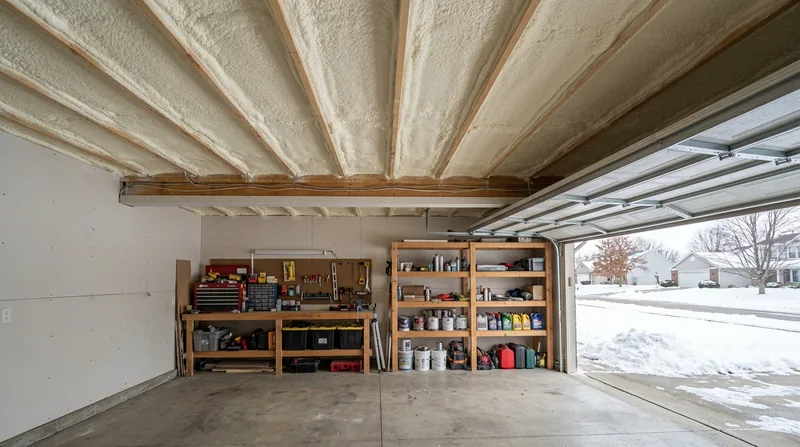




Garage spray foam insulation in Lafayette transforms an uninsulated or poorly insulated garage into a climate-controlled space that protects vehicles, tools and stored goods from the temperature swings that define north-central Indiana. Lafayette winters drop below zero and summer heat bakes attics and roof decks; a garage that sits uninsulated becomes a thermal sieve, letting conditioned air from the house pour out through shared walls and ceilings. Spray foam seals and insulates in a single application, stopping air leaks that fiberglass batts cannot reach and creating an R-value that holds steady through the seasonal humidity and temperature swings of the Wabash River valley. Whether your garage is a single-bay workshop in an older Ninth Street Victorian, a two-bay attached structure on a 1970s ranch in Columbian Park, or a bonus-room garage under a 2000s two-story in south Lafayette, the principle is the same: controlled air and stable temperature mean lower utility costs, fewer ice dams on adjacent rooflines, and a usable space year-round. We spray foam garages across Lafayette, West Lafayette, Battle Ground, Dayton and the surrounding Tippecanoe County area, and we start every job with a written estimate that names the R-value, foam thickness and method so you know exactly what you are paying for.
Why Garage Insulation Matters in Lafayette's Climate
An uninsulated garage in Lafayette is an open door to the outdoors. In winter, a garage that shares a wall or ceiling with your living space becomes a cold sink that pulls heat through studs, rim joists and headers into the unconditioned void. In summer, the same garage radiates heat back into the house, forcing your air conditioning to work harder and longer. The Wabash River valley's humid summers and frozen winters create a vapor-drive cycle that reverses twice yearly, and fiberglass batts installed in garage walls or ceilings absorb moisture, sag, and lose their R-value over time. Spray foam blocks both temperature transfer and air infiltration, and because it is a closed-cell or open-cell plastic matrix, it resists moisture absorption and maintains its insulating value for decades.
- Spray foam seals air leaks that single-layer drywall and fiberglass cannot reach, stopping the stack effect that pulls cold air from the garage into living spaces above.
- Closed-cell foam creates an air barrier and vapor retarder in one step, protecting rim joists and band joists from condensation and ice formation in winter.
- Open-cell foam is less dense and less expensive, and works well in attached garages where the primary goal is thermal insulation and sound dampening rather than vapor control.
- A properly insulated garage ceiling prevents ice dams on the roofline between the garage and the house, a common failure point in older Lafayette homes.
- Garages used as workshops, storage or hobby spaces become usable year-round when insulation and air sealing bring the temperature within 10 to 15 degrees of the living space.
The best way to verify what applies at your address is to contact the Lafayette Building and Zoning Department or the city where your property sits; they will confirm whether a permit is required for garage insulation and whether any thermal barrier or ignition barrier is mandated by the current energy code.
Key info: Garages in Lafayette's older neighborhoods, especially near Purdue on the west side and along Ninth Street Hill, often have uninsulated rim joists and headers that frost in winter and sweat in summer. Spray foam stops that cycle and protects the structural wood underneath.
How We Insulate Garages in Lafayette: Our Process
A garage spray foam job starts with a site visit where we assess the existing structure, identify air leaks and thermal breaks, measure the square footage of walls and ceilings, and confirm whether the garage is attached or detached. We then prepare a written estimate that specifies the foam type (closed-cell or open-cell), the target R-value, the thickness in inches, and the coverage area. Once you approve the estimate, we schedule the work, prepare the space, spray the foam in controlled passes to achieve the target thickness, allow the foam to cure, and trim excess material flush with the framing. The entire process typically takes one day for a standard two-car attached garage, and we provide a re-entry window of 24 to 48 hours before the space is fully safe for occupancy.
- We inspect the garage structure, identify existing insulation, air leaks, electrical outlets and mechanical penetrations, and measure the square footage of walls, ceilings and rim joists.
- We prepare a written estimate naming the foam type, R-value per inch, total thickness, coverage area and labor cost, with no surprises at the end of the job.
- Before spraying, we cover HVAC ducts, electrical panels, lights and any equipment that should not be coated, and we ventilate the space mechanically during application.
- We spray the foam in controlled passes, allowing each layer to set before applying the next, so the final thickness is uniform and matches the estimate.
- We trim excess foam flush with the framing, install any required thermal barrier or ignition barrier per code, and clean up all debris before we leave.
- We provide written guidance on the re-entry window and any post-cure ventilation needed, and we remain available by phone if questions arise during the cure period.
Every garage is different, and the specifics of your job depend on the age of the structure, whether walls are already drywall-covered, and whether you are insulating walls, ceilings, rim joists or a combination. Our estimate process handles that complexity upfront, so there are no surprises when the crew arrives. For more detail on how we approach air sealing and insulation in older and newer homes across the Greater Lafayette area, visit our air sealing page.
Example: A two-car attached garage in Battle Ground with a vaulted ceiling and uninsulated rim joist typically takes 4 to 6 hours to spray, cure and trim. If the garage ceiling is also uninsulated drywall, we spray the underside of the roof deck, achieving R-20 to R-30 depending on foam type and thickness. The shared wall between the garage and the house gets special attention to stop air leakage and thermal bridging.
Garage Spray Foam Insulation Methods: Closed-Cell vs. Open-Cell
| Approach | Description | Best for |
|---|---|---|
| Closed-Cell Spray Foam | Dense, rigid foam with an R-value of 6.5 to 7 per inch. Acts as both insulation and air barrier. Resists moisture and vapor drive. Adds structural rigidity to walls and ceilings. | Attached garage walls and ceilings where vapor control and structural support matter. Rim joists and band joists in basements and crawl spaces. Garages in older homes with moisture concerns. |
| Open-Cell Spray Foam | Lighter, softer foam with an R-value of 3.5 to 3.7 per inch. Allows vapor transmission. Absorbs sound better than closed-cell. Lower cost per board foot. | Detached garages where moisture control is less critical. Workshop spaces where sound dampening is desired. Budget-conscious projects where R-value per dollar matters more than vapor control. |
| Closed-Cell with Thermal Barrier | Closed-cell foam sprayed over rim joists and into wall cavities, with drywall or intumescent paint applied to meet the fifteen-minute thermal barrier requirement of the energy code. | Attached garages in Lafayette and West Lafayette where code requires a thermal barrier between foam and living space. Protects foam from ignition in the rare event of a garage fire. |
| Open-Cell with Sound Dampening | Open-cell foam applied to garage ceilings and shared walls to reduce noise from vehicles, tools and machinery. Allows vapor to move, reducing condensation risk in detached garages. | Hobby garages, home gyms and workshops where noise isolation improves usability. Detached garages in Dayton, Battle Ground and rural areas where vapor control is not a primary concern. |
The choice between closed-cell and open-cell foam depends on whether the garage is attached or detached, whether moisture or vapor control is critical, and your budget. An attached garage in an older Lafayette home benefits from closed-cell foam because it acts as an air barrier and vapor retarder, protecting the shared wall from condensation and air leakage. A detached garage or workshop in Stockwell or Otterbein may be better served by open-cell foam, which is less expensive and still delivers solid insulation without the vapor-control overhead. Our estimate process walks you through that choice and explains the trade-offs so you can make an informed decision.
Garage Spray Foam Insulation Cost in Lafayette: What to Expect
Garage spray foam insulation in Lafayette typically starts at $1,200 for a single-car garage with walls and ceiling, and scales upward with the size of the space, the foam type selected, and the target R-value. A standard two-car attached garage with 500 to 600 square feet of wall and ceiling area runs $2,500 to $4,500 depending on whether you choose open-cell or closed-cell foam and whether rim joists and band joists are included. The biggest cost drivers are the square footage to be covered, the thickness required to reach your target R-value, whether the garage is attached or detached, and the complexity of the existing structure. If your garage has exposed framing and no existing insulation, the cost per board foot is lower because there is no removal work. If you are retrofitting a garage with old fiberglass batts or mineral wool, we factor in insulation removal before we spray, which adds time and cost but is necessary for a clean, effective installation.
The best way to understand what your garage will cost is to call us at (765) 441-6823 and schedule a free, no-obligation estimate. We visit your property, measure the space, assess the existing structure, and provide a written quote that breaks down the foam type, R-value, thickness, square footage and total labor cost. That estimate is good for 30 days and comes with no obligation to book. If you want to compare costs, we encourage you to get 2 or 3 estimates from other spray foam contractors in Lafayette and West Lafayette. When you do, ask each contractor for the same specifics: foam type, R-value per inch, total thickness, square footage and the re-entry window after spraying. Estimates that lack those details are a red flag, because they are not based on a proper site assessment and you have no way to verify that the work meets code or delivers the promised R-value.
For a full breakdown of our pricing structure and typical costs for other spray foam services across Lafayette and the surrounding areas, see our pricing page.
What to Look for When Hiring a Spray Foam Insulation Contractor Near Lafayette
Hiring a spray foam contractor is a straightforward process if you know what to verify. Start by asking whether the contractor is fully insured and carries general liability and workers' compensation coverage; request a certificate of insurance and verify that it covers spray foam application work. Ask for a written estimate that names the foam type, R-value per inch, total thickness, square footage, and labor cost. Avoid any estimate that quotes a price per board foot or per square foot without an on-site inspection, because spray foam is measured and priced on site and no legitimate contractor can quote a firm price without seeing the space. Check whether the contractor has experience in your neighborhood, whether that is Ninth Street Hill in Lafayette, the Purdue-adjacent streets of West Lafayette, or the newer subdivisions in Battle Ground and Dayton. Ask for references from recent jobs in similar homes and call at least two to confirm the work quality and timeline. If your garage has historical significance or sits in a homeowners' association with architectural rules, ask the contractor whether they have experience navigating those restrictions; most garage spray foam work does not require HOA approval, but it is worth confirming upfront.
- Verify that the contractor is fully insured with general liability and workers' compensation coverage, and request a certificate of insurance before work begins.
- Ask for a written estimate that specifies foam type, R-value, thickness, square footage and labor cost, and compare 2 or 3 estimates to understand the market range.
- Confirm that the contractor will provide mechanical ventilation during application and a stated re-entry window of 24 to 48 hours before the space is safe for occupancy.
- Check references from recent jobs in similar homes and neighborhoods, and ask whether the contractor has experience with older or newer construction in the Greater Lafayette area.
- Ask whether the contractor will handle any required permits or whether you are responsible for pulling them; verify with your local building department what applies at your address.
- Confirm that the contractor will trim excess foam flush with the framing and install any required thermal barrier or ignition barrier per the energy code in force at your location.
The spray foam trade has rig-and-run crews that spray a job in an afternoon and disappear when the smell will not go away, and it has national franchises that promise savings that do not materialize. A local, independent contractor who is fully insured, provides written estimates with R-value and thickness specs, and remains available by phone after the work is done is your best protection. For a free estimate and answers to your questions about garage spray foam insulation in Lafayette, West Lafayette or any of the surrounding towns, contact us at (765) 441-6823 or visit our contact page.
Garage Spray Foam Insulation in Lafayette: Pricing Guide
| Service | Price | Details |
|---|---|---|
| Single-car garage (walls and ceiling) | Starting at $1,200 | Open-cell foam, 4 to 5 inches, 250 to 300 sq ft coverage, includes site prep and trim |
| Two-car attached garage (walls, ceiling and rim joist) | Starting at $2,500 | Closed-cell or open-cell foam, 4 to 6 inches, 500 to 600 sq ft, includes removal of old insulation if present |
| Garage with existing insulation removal and re-insulation | On estimate | Cost depends on amount of fiberglass or mineral wool to remove and disposal, plus new foam application and thickness |
| Rim joist and band joist sealing only | Starting at $800 | Closed-cell foam, 2 to 3 inches, typical for basement or crawl space perimeter, prevents condensation and air leakage |
| Travel and site visit | Included | No separate mileage or call-out fee for Lafayette, West Lafayette, Battle Ground, Dayton and surrounding Tippecanoe County |
| Free written estimate | No charge | Response within 24 hours, includes R-value, thickness, square footage and labor cost, no obligation to book |
Indicative pricing, the exact cost depends on square footage, finish, and site access. Free personalized estimate within 24h at (765) 441-6823.


