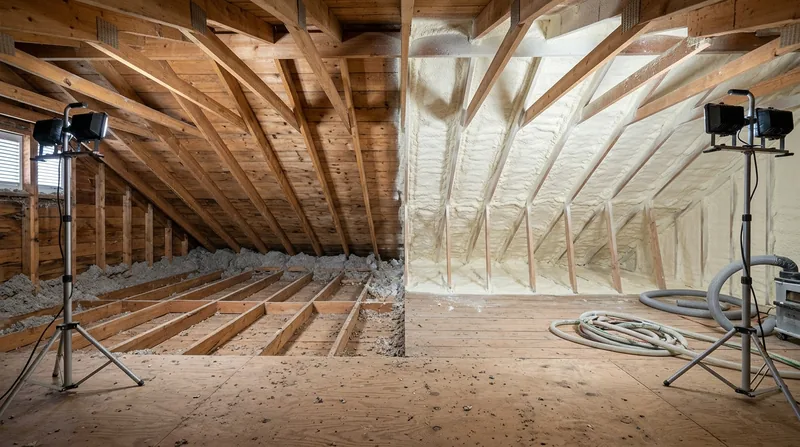




Homes across Lafayette and West Lafayette face a relentless cycle of temperature swings and seasonal moisture that degrades insulation over time. Attics that bake above 130 degrees in July and plummet below zero in January, combined with the humid Wabash Valley summers, break down fiberglass, mineral wool, and cellulose faster than in most climates. Victorian and foursquare homes on Ninth Street Hill and Centennial, 1920s Capes on the east side, and mid-century ranches in Vinton all accumulate settled, compressed, or water-damaged insulation that no longer performs. When your heating and cooling bills climb, ice dams form despite gutters, or cold spots appear in upstairs bedrooms, insulation replacement and re-insulation in Lafayette becomes not just an upgrade but a necessity. We remove failed insulation, seal air leaks around it, and install spray foam or blown-in insulation that handles the local climate. A free estimate from our team includes written R-value and thickness specs so you know exactly what you are getting. Call (765) 441-6823 or visit our contact page to schedule a walkthrough.
Why Insulation Replacement Matters in Lafayette's Climate
The Wabash Valley's temperature extremes and seasonal humidity swings attack insulation from both sides. Winter ice dams on older homes signal that attic insulation has settled and lost contact with the roof deck, allowing warm air to escape and melt snow. Summer heat drives moisture deep into fiberglass batts, promoting mold and fiber breakdown. Homes built before 1980, especially those with balloon-framed walls and knee walls, often contain original fiberglass that has compressed to half its rated R-value or sits unevenly, leaving cavities uninsulated. Even newer ranch and Cape Cod homes in areas like Battle Ground and Dayton can suffer from improper installation, missing baffles, or undersized cavities that were never filled correctly.
- Settled or compressed fiberglass loses 40 to 60 percent of its R-value within 15 to 20 years in humid climates.
- Water-damaged insulation traps moisture and breeds mold, reducing its thermal resistance and creating indoor air quality issues.
- Gaps and voids in old insulation create thermal bridges that ice dams exploit, leading to costly roof leaks.
- Replacing failed insulation with spray foam or dense-pack blown-in stops air leakage and restores thermal control.
Replacing old insulation is the most direct way to recover energy performance and stop the drafts and cold spots that define a poorly insulated Lafayette home.
Key info: Lafayette building code requires attic ventilation in vented attics and thermal barriers between foam and living space. We handle both during replacement so your installation passes inspection and meets code. Contact the Lafayette building department to confirm what applies to your address.
For more on how failed insulation develops, see our page on insulation removal, which is often the first step of a replacement project.
How Insulation Replacement Works: Our Process in Lafayette
We start with a full attic or crawl space walkthrough, measuring insulation depth, checking for water damage or pest intrusion, and identifying air leaks around penetrations, rim joists, and ductwork. We photograph the existing condition and write an estimate that specifies the R-value and thickness we will install, the type of insulation (spray foam, blown-in, or a combination), and any air sealing work needed to complete the job. Once you approve, we schedule removal on one day and installation on the next, minimizing disruption and allowing mechanical ventilation to run during foam cure.
- Inspect attic, crawl space, or walls to assess existing insulation condition, moisture, and air leak locations.
- Write a detailed estimate with R-value, thickness, material type, and labor, plus the cost of removal and disposal.
- Remove old insulation, baffles, and any debris, and haul it off site.
- Air seal rim joists, band joists, pipe penetrations, and ductwork with spray foam or caulk.
- Install new insulation to spec, maintaining proper thickness and coverage in all cavities.
- Verify mechanical ventilation during cure and confirm re-entry timing before handing off the space.
The entire process is transparent: we show you the before and after, explain what we found, and answer questions before work starts.
Example: A 1950s ranch in Lafayette with a vented attic over a knee wall needed the original 2 inches of settled fiberglass replaced. We removed 1,200 square feet of old batts, air sealed the rim joist and roof penetrations with closed cell foam, and installed 5.5 inches of open cell spray foam for R-22 coverage. The work took two days, the attic stayed dry, and winter bills dropped because no more air was leaking through the old cavities.
Learn more about open cell spray foam and closed cell spray foam options for your replacement project.
Insulation Replacement Methods: Choosing the Right Material
The method you choose depends on your space, budget, and climate exposure. Spray foam seals air leaks as it insulates, making it ideal for attics with complex geometry, rim joists, and crawl spaces where air tightness matters. Blown-in fiberglass or cellulose is cost-effective for simple attics with good access and existing cavities. A hybrid approach, combining spray foam for air sealing and blown-in for bulk R-value, often delivers the best balance of performance and cost.
| Approach | Description | Best for |
|---|---|---|
| Open Cell Spray Foam | Low-density foam that expands and hardens in place, achieving R-3.5 per inch. Breathable, allowing vapor transmission. Low-VOC once cured. Requires mechanical ventilation during application. | Attics, knee walls, bonus rooms over garages. Cost-effective air sealing when R-value 15 to 25 is the target. |
| Closed Cell Spray Foam | High-density foam with closed cell structure, achieving R-6 per inch. Vapor-impermeable, moisture-resistant. Excellent for crawl spaces, rim joists, and metal buildings where moisture control is critical. | Crawl spaces, rim and band joists, metal buildings, barndominiums. Vented attics where rim joist sealing is the goal and roof deck remains vented. |
| Blown-in Fiberglass or Cellulose | Loose-fill insulation blown into cavities to a target density. Fiberglass settles slightly over time; cellulose is denser and resists settling. Both are cost-effective for attics with good access. | Simple attic geometries, top-ups of sound existing insulation, budget-conscious replacements. Not suitable for air sealing or moisture-prone spaces. |
| Hybrid: Foam + Blown-in | Spray foam applied to air leak points (rim joists, penetrations, eaves), then blown-in fiberglass or cellulose over the field for bulk R-value. Combines air sealing and cost control. | Older Lafayette homes with complex attics, vented attics needing both air sealing and high R-value. Balances performance and budget. |
Insulation Replacement and Re-Insulation Cost in Lafayette: What to Expect
The cost of insulation replacement depends on the size of the space, the depth and type of insulation you choose, the condition of the existing material, and whether air sealing is included. A straightforward attic replacement in a 1,200 square foot ranch in Lafayette or West Lafayette typically starts around $2,800 to $4,500 for blown-in fiberglass, and $5,000 to $8,000 for spray foam with air sealing. Crawl spaces and rim joist work cost more per square foot because of access and moisture control demands. Older Victorian and foursquare homes with complex attic geometry, knee walls, and multiple penetrations cost more to insulate properly because every cavity must be filled and every air leak sealed.
The best way to know your cost is to get a written estimate that specifies R-value, thickness, square footage, and labor. We include removal and disposal in our quotes, and we never charge a call-out or estimate fee. See our full pricing overview for more detail on what moves the cost up or down.
Call (765) 441-6823 for a free estimate within 24 hours, or use our contact form to request a time that works for you.
What to Look for When Hiring an Insulation Replacement Contractor Near Me in Lafayette
The insulation market includes rig-and-run crews that spray a job in an afternoon with no ventilation and vanish, and national franchises with high overhead but limited local accountability. A local contractor with a local address and a reputation in Lafayette offers the best middle ground. Before you hire, verify that the contractor is fully insured, get multiple written estimates that specify R-value and thickness, and ask for references from recent jobs. Check whether the contractor has worked with your city's building department and understands local permit and ventilation rules. If your home is in an HOA like New Chauncey or Hills and Dales, confirm that any exterior work meets architectural guidelines.
A good estimate includes the cost of removal, the R-value and thickness of new insulation, air sealing details, mechanical ventilation during cure, and a re-entry window of 24 to 48 hours. If an estimate offers no R-value spec, promises immediate re-entry, or quotes a price far below the market, walk away. Insurance and references are not optional: call the contractor's insurer to verify coverage and speak directly to two or three homeowners about their experience.
We are fully insured and have been in business since 2012. Our estimates include written R-value and thickness specs, and we answer questions before and after the job. Contact us at (765) 441-6823 or visit our contact page to schedule a free walkthrough.
Insulation Replacement & Re-Insulation in Lafayette: Pricing Guide
| Service | Price | Details |
|---|---|---|
| Blown-in Fiberglass Attic Replacement | Starting at $2,800 | 1,200 to 1,500 square feet, R-38 coverage, removal and disposal included, simple geometry |
| Open Cell Spray Foam Attic with Air Sealing | Starting at $5,000 | 1,200 square feet, R-22 coverage, rim joist and penetration sealing, mechanical ventilation during cure |
| Closed Cell Spray Foam Crawl Space or Rim Joist | Starting at $3,500 | 400 to 600 linear feet of rim joist, moisture control, vapor barrier, access and moisture condition affect final price |
| Complex or Multi-Room Replacement | On estimate | Attics with knee walls, bonus rooms, multiple levels, or significant moisture damage require site assessment |
| Removal and Disposal | Included | in all replacement projects, hauling and site cleanup are part of the quoted labor |
| Free Estimate | No charge | Response within 24 hours at (765) 441-6823, written specs with R-value and thickness, no obligation |
Indicative pricing, the exact cost depends on square footage, finish, and site access. Free personalized estimate within 24h at (765) 441-6823.


